Neither Sentimentality nor Resignation
The honest thing to say at the end of a volume like this is that writing it has not helped.
The five perspectives set out in these chapters converge on a finding that arrived not by choice but by accumulation. The city in question has not collapsed; it has not been bombed, flooded or abandoned; no single catastrophe marks the boundary between what it was and what it is becoming. What has happened is at once less dramatic and less reversible: the conditions under which ordinary residents could inhabit it without constant, low-grade administrative combat have been quietly withdrawn, not by decree but by the accumulated weight of a thousand decisions, each of them rational, none of them designed to be answered for.
This volume has not proposed solutions. Not because solutions do not exist — they may — but because the kind of knowledge a resident accumulates by staying in a place and paying systematic attention to its decline is not the kind of knowledge from which policy follows. It is the kind of knowledge from which discomfort follows, and discomfort is what the volume has been trying not to waste. The temptation, at this point, is to convert the discomfort into one of two available currencies: grief for what has been lost, which is sentimentality; or the shrug that concedes the loss was inevitable, which is resignation. Both are available. Both are, in their way, a relief. And both are forms of the same concession — that description, having been completed, can now be set aside.
Setting it aside, however, is not available to anyone who was paying attention on a Saturday in April, when people walked through thirty-nine cities with keys in their hands and placards whose slogans had the compressed clarity of things that should not need to be said. Your Airbnb was my house. Dwellings should be dwellings. Ministry not of housing — of survival. On lampposts and faculty noticeboards, other notices — smaller, unsigned, more abject — continued to appear: responsible and quiet person seeks home. The author of that sentence had done everything the city asked of her. She had qualified, presented herself, and explained, with the compressed politeness of someone who has learned that the explanation must be brief, that she was not a risk. The sentence stayed on the lamppost. The city did not answer it.
Recording these things is not the same as opposing them. But there is a prior step to opposition which consists in not looking away, and which requires a tolerance for one’s own uselessness that is surprisingly difficult to maintain. The volume ends here, not because the material is exhausted but because the limit of what description can do without becoming something else — a programme, a plea, a manifesto — has been reached. The city is still there. So is the narrator. Neither of these facts is as reassuring as it sounds.
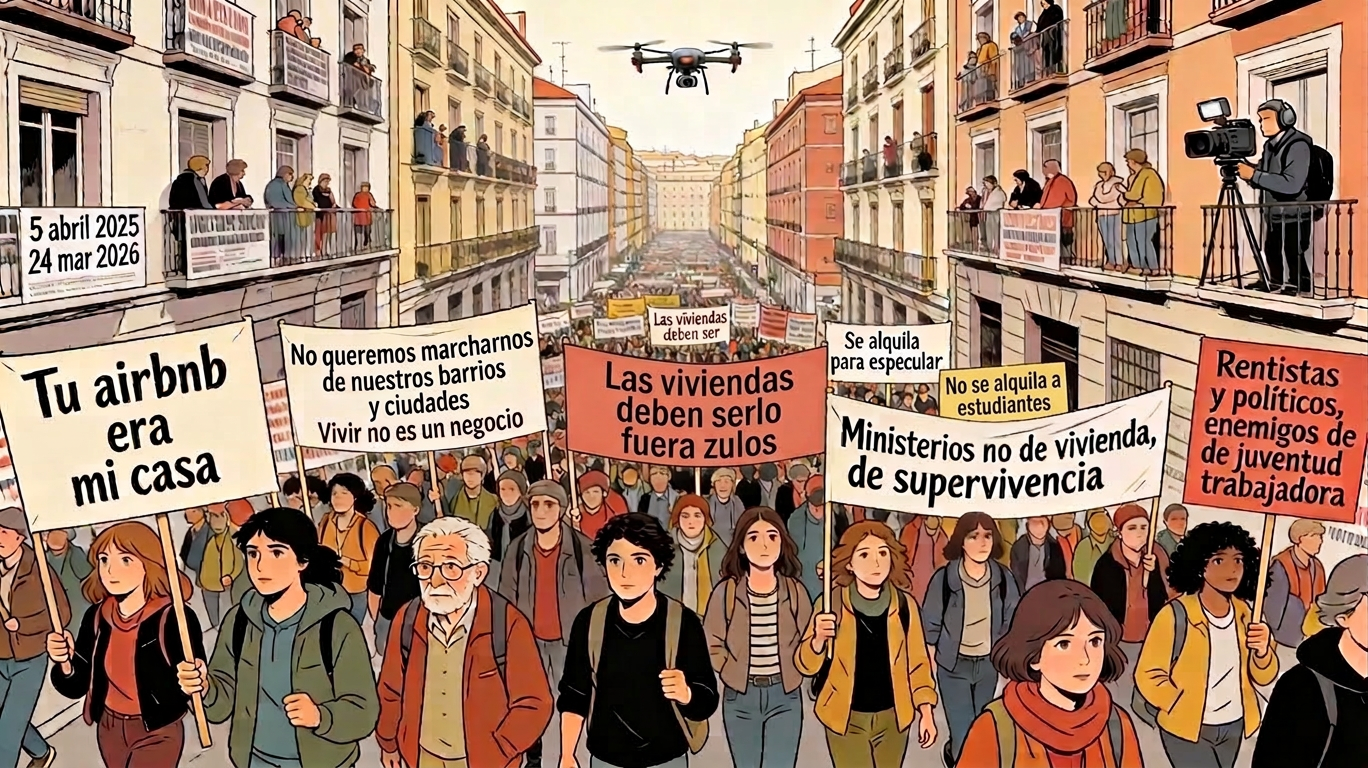
Plate XI. Public demonstration for the right to housing, Spanish city, two dates recorded. The placards and protest banners are legible. The demands are constitutional. The march continues past the frame.