Patterns of Decline
What the City Is Really Losing
Patterns, in the plural, is the word one reaches for when a single noun would be too precise and the reader would object. The plural protects everyone involved, and the chapter will try to do without it where it can.
The five chapters that precede this one were written as five perspectives on what appeared, at the outset, to be five separate problems. The returning resident was losing a neighbourhood. The commuter was losing a working relationship with his own streets. The citizen without organised leisure was losing the conditions of ordinary rest. The flâneur was losing the park. The student and her reluctant guide were losing, between them, the city’s willingness to house the people it had agreed to educate. At no point during the drafting of those chapters was the narrator able to sustain, for more than a few paragraphs, the impression that he was describing five problems. The impression kept collapsing into one. The one is what this chapter is for.
The process the five perspectives were each describing is not a deterioration of the city in the sense in which a building deteriorates — by accumulating faults that a sufficiently determined maintenance budget could eventually address. It is a reorganisation of what the city is for. The ordinary civic purposes — living, moving, resting, walking, studying — have not been abolished; they have been demoted to the status of residual uses, tolerated where they do not interfere with the extraction of rent, and quietly relocated where they do. The word that has been waiting, unused, through the preceding chapters is the one the volume has been circling from the start, and the chapter will now have to let it appear without further cover: the city has been reconstituted as a platform of value extraction, and the five perspectives were five views of the same reconstitution.
The mechanism is not mysterious, and has been described, for rather longer than the present situation has existed, by people whose business is precisely to describe such mechanisms. David Harvey’s observation, in the book from which this chapter borrows its spine, is that urban rent functions as a form of capital accumulation in its own right, and that once a city’s built environment has been recognised as a yielding asset by the sort of capital that was previously placed elsewhere, the uses to which that environment is put will be reorganised in whatever way maximises the yield (Harvey, 2012). Henri Lefebvre’s rather older claim is that the right to inhabit a city is a political claim and not a consumer preference, and that when the claim ceases to be recognised the inhabitants discover, in succession, that they are being treated as an obstacle to a process whose beneficiaries are elsewhere (Lefebvre, 1968). The two observations do not need to be reconciled. They describe, between them, both the movement of capital into the built environment and the corresponding displacement of the civic claim that the previous inhabitants had imagined themselves to hold. No further theoretical scaffolding is required, and the chapter will not supply any.
The critical feature of this mechanism — the one that resists satisfying explanation because it refuses to take the shape the explanation wants — is that it does not require anyone to have decided it. There is no meeting at which the conversion of a city into a platform is announced. There is a market in short-stay accommodation, a market in licences, a market in commercial space along the main pedestrian routes, a market in the attention of visitors with a limited number of days to spend, and a set of institutional actors whose function would notionally be to regulate some of these markets and whose practice has been, at best, to lag behind them. The aggregate behaviour of the actors inside these markets is the process. It has the convenience, from the point of view of anyone trying to resist it, of belonging to no one in particular.
The convenience, however, is overstated, and the structural innocence of markets is one of the more durable fictions of the present moment. The chapter is not obliged to respect it. There are agents, and they are identifiable. They include the proprietors who converted long lets into short-stay units at the first opportunity the tax code permitted; the intermediary platforms whose interface has taken the place of any prior relation between tenant and landlord; the estate agencies whose fee is now called a management charge because the original name is illegal; the tour operators who discovered that a historic quarter can be consumed at the rate of several cohorts per day; and the municipal actors whose reluctance to act has been sufficiently consistent over sufficiently many council terms to qualify as a position rather than a lapse. Naming them does not require a conspiracy; only arithmetic.
A further observation is required at this point, and it is the one the chapter has been postponing. In the kind of environment the preceding chapters have described — one in which ordinary transactions are conducted under a steady pressure of small urgencies, advertised on walls and noticeboards, experienced by actors whose margins are narrow enough that the next rent is a real question — the morally uncomfortable roles are exchanged with an ease that would be disturbing if it were not, at this point, ordinary. An outgoing tenant reproduces, without apparent hesitation, the practices of the landlord who was about to defraud him of his own deposit. A small agency lends administrative cover to an arrangement it would, in any calmer market, have declined to be associated with. A long-standing resident accepts a weekly let on his second flat not because he holds a settled view on the conversion of housing stock into tourist accommodation, but because the arithmetic has made the alternative look like a hobby. The precarity is, among other things, a solvent. It dissolves the distinctions the volume was planning to rely on.
I notice I am being fair to the wrong parties, and I should correct course. The observation that precarity degrades everyone’s conduct is accurate; the observation that the degradation is symmetrically distributed is not, and the chapter will not permit the register of even-handedness to obscure the ordering. The actors who profit most from the precarity are the actors who organised the conditions under which it became profitable: the proprietors with scruples they have elected to do without, the agencies that recognise a vulnerable applicant and adjust their demands upwards accordingly, the intermediaries whose entire business model rests on the inability of newcomers to verify what they are being told. The solvent dissolves distinctions; it does not redistribute responsibility. The small compromises of the people further down the chain are consequences of the architecture, not contributions to it.
The chronology is available to anyone willing to look at it. The principal acceleration is post-2014 and has two phases: the consolidation of the short-stay platforms as the dominant interface between visitor and building, and the post-2021 return of international arrivals at volumes the pre-pandemic baseline would have classified as exceptional. The pre-2014 conditions were not a paradise, and the volume has been careful not to pretend otherwise; they were a baseline against which the subsequent decade has moved in a direction that no one with a serious interest in the continuity of civic life would have chosen, had they been asked in advance, and which very few of them were.
What the diagnosis leaves us with is not a list of policy levers, which the volume has promised not to produce, and not a set of actionable recommendations, which it would in any case be the wrong instrument to deliver.
It also leaves us, and the chapter will permit itself to say this once and then let the rest of the volume take over, with a modest unsolicited observation about the formation of the young people who will shortly be asked to enter the conditions the preceding chapters have described. The months immediately before university — the months a serious educational system would otherwise devote to Latin verbs, to the structure of a sonata, to the rudiments of a political tradition — might now, on any honest reading of the environment into which the student is about to be delivered, be more profitably spent on a rather different curriculum: the verification of an online rental listing, the detection of a fraudulent deposit, the administrative anatomy of a management fee that is technically illegal, the small courtesies by which a cohabitant can be persuaded not to retaliate when the sofa is required. These skills would, in the short term, improve the probability that the student reaches her second semester with her nervous system intact. Over the longer term, if the present trend continues along its present line, they would equip her for the entirety of her working life in the city she is about to be matriculated in, which is a benefit a careful educator would find difficult to dismiss. The chapter does not propose this as a reform. It proposes it as a description of what a reform would, in the present circumstances, have to concede it was teaching.
The city has been reconstituted as a platform of value extraction. The agents are identifiable, the chronology is available to anyone willing to consult it, and the cost is being borne by the people the preceding chapters have named. The description has been the product, offered without the consolation of a resolution that is not available. The remaining discomfort is the coda’s.
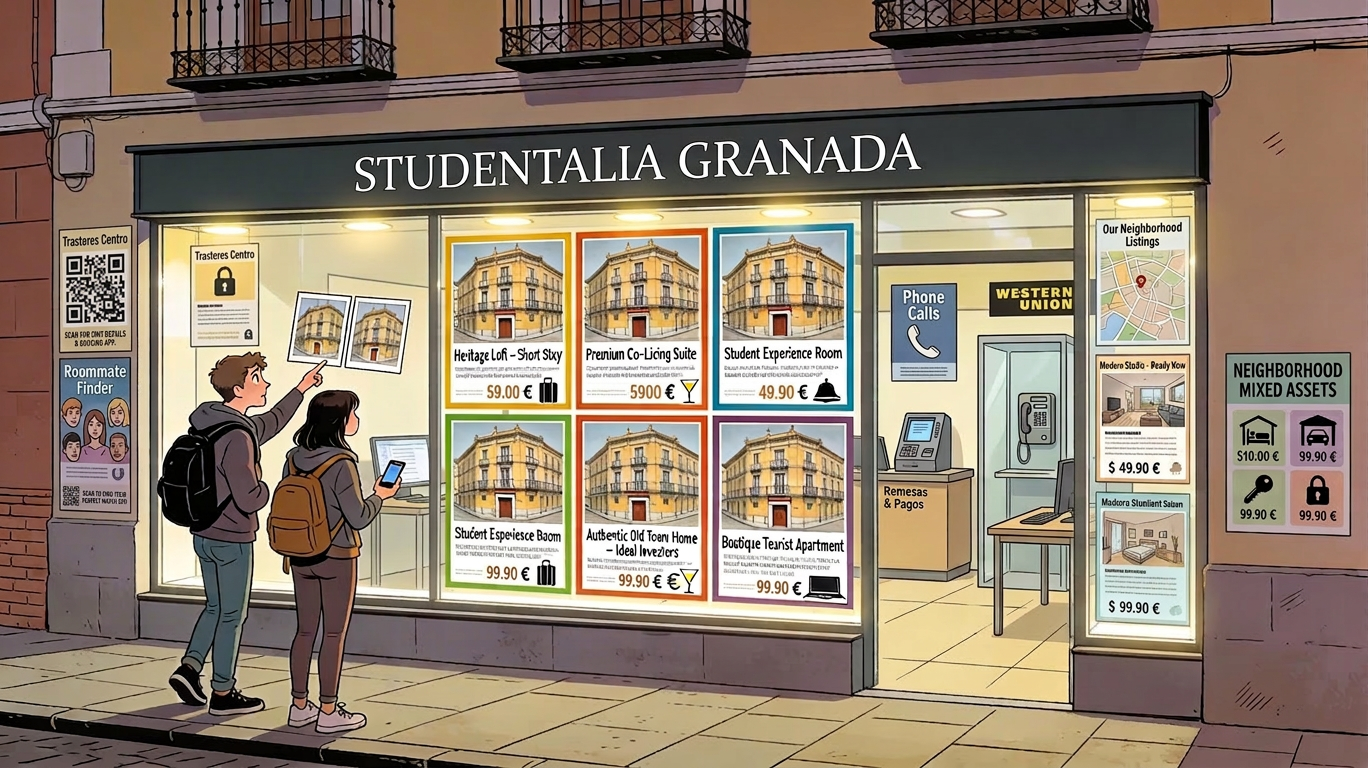
Plate X. Estate-agency window, central Granada, evening. The premises trade as Studentalia Granada, a name whose target demographic the signage has not thought it necessary to disguise. Six identical photographs of the same ochre corner building appear in the window, each repackaged under a different commercial heading — Heritage Loft, Premium Co-Living Suite, Student Experience Room, Authentic Old Town Home for the Ideal Investor, Boutique Tourist Apartment, and a second Student Experience Room whose repetition the agency, if asked, might or might not have explained. Two students consult the display; one points, the other is already on her telephone, and neither expression contains anything resembling surprise. To the right of the listings, the same premises offer Western Union remittances, phone booths and an ATM, so the building’s principal trade — estate agent, locutorio, or efficient compression of both — remains, with pleasing ambiguity, part of the exhibit.